WELCOME TO TYRONEGETER.COM

Fine Art For Fine People
GETTING TO KNOW ME

Rodney, Me, Antar, Cosmo
A TALE OF TWO TYRONES
People sometimes imagine that an artist begins with a clear plan. My process works differently. Much of the work begins with a quiet conversation between two parts of my mind. One reacts instinctively to the world around me. It notices gestures, expressions, or moments that carry emotional weight and begins to imagine what they might become. That first response comes from the subconscious. It observes, reflects, and begins to build possibilities long before the conscious mind fully recognizes what is happening. Eventually the more deliberate part of the mind steps in. It questions the idea, challenges it, and tests whether it deserves to become a finished work. If the two do not agree, the idea waits. Over time the subconscious continues to develop it until the direction becomes clear. This same dialogue guides the way I build an image. I do not begin with preparatory sketches. Instead, I develop the composition directly on the surface, responding to each decision as it unfolds. Each mark leads to the next. By listening carefully to that inner exchange, the work grows in its own direction. It is a process that takes patience, but it keeps the work honest and allows the image to become something uniquely its own.
People sometimes imagine that an artist begins with a clear plan. My process works differently. Much of the work begins with a quiet conversation between two parts of my mind. One reacts instinctively to the world around me. It notices gestures, expressions, or moments that carry emotional weight and begins to imagine what they might become. That first response comes from the subconscious. It observes, reflects, and begins to build possibilities long before the conscious mind fully recognizes what is happening. Eventually the more deliberate part of the mind steps in. It questions the idea, challenges it, and tests whether it deserves to become a finished work. If the two do not agree, the idea waits. Over time the subconscious continues to develop it until the direction becomes clear. This same dialogue guides the way I build an image. I do not begin with preparatory sketches. Instead, I develop the composition directly on the surface, responding to each decision as it unfolds. Each mark leads to the next. By listening carefully to that inner exchange, the work grows in its own direction. It is a process that takes patience, but it keeps the work honest and allows the image to become something uniquely its own.

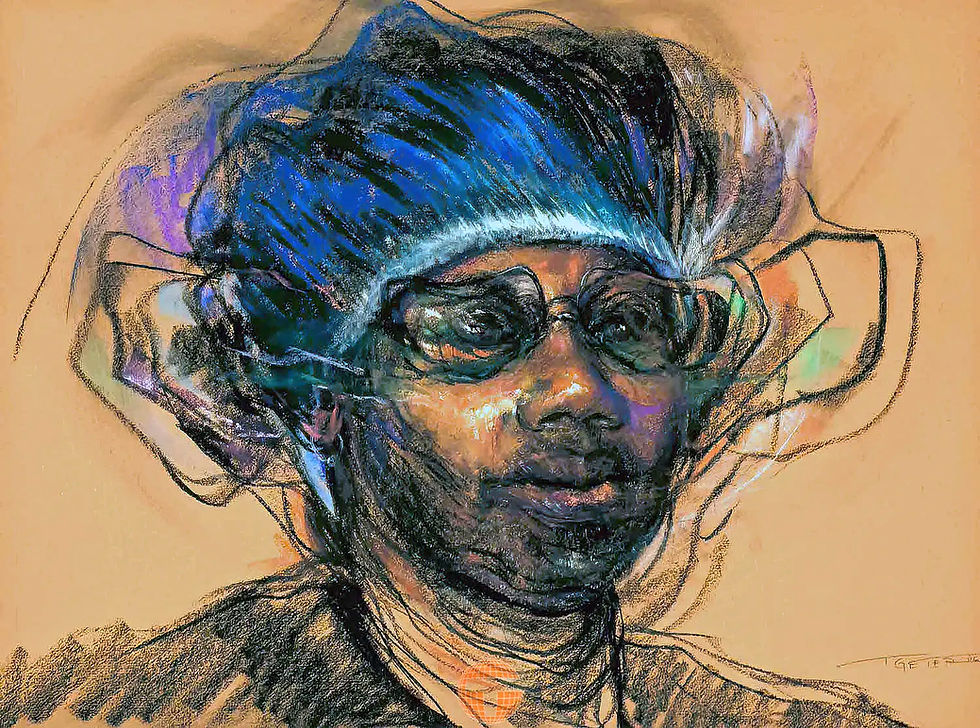
Hauwa Tini Geter
NIGERIA Those years in Nigeria proved to be a turning point in my development and the most important influence in my life and art. Like my mother’s teachings, Nigeria was one of life’s great lessons for me. Ever since, my work has prioritized showing what it means “to be human” a global environment. My mother taught me that the only way to salve a personal pain was to heal the collective. During my entire career, I’ve focused on the struggles of people of color, women and children particular and everyone else in general . Along with our struggles, my work aims to embody our dreams, love, compassion, hope, justice, and perseverance—concepts I learned from my mother. The past few years, my work has grown more concerned with climate change, environment, and what we will leave behind for future generations. My use of different materials, from charcoal, to torn paper, found objects, and natural elements like tree limbs, serve to depict people as complex on the canvas as we exist in the world. My use of materials and how I blur the lines between figurative and my own spiritual reality, is one way to remind the viewer that it's our collectivity that places the impossible within our reach.
ARTIST STATEMENT My mother once told me that sometimes she felt like she “didn’t have no life.” That statement, made with so much honesty, conviction, and passion, yet free of even a hint of self-pity has throughout my career been one of the guiding principles of not only how I live my life, and relate to other people, but has also profoundly influenced the philosophy of my art. In the early 1900s when she grew up, life was a struggle. Survival was day-to-day and filled with the perils of discrimination, poverty, illiteracy and a host of other dangers inherited from a lifetime of being poor, black and undereducated. Yet she survived and passed her legacy of love, compassion, hope and a sense of “doing the right thing” on to her children. Years later, on a break from my first year at Ohio University where I was only the second black student in the school’s history to receive an MFA in painting from Ohio University, I showed her a still life paintings of bottles that I was very proud of. My mother looked at it and said, “Who it going to help and if it ain’t going to help nobody, why you doing it?” My mother was more concerned with what my life would contribute than the medium I would use to live it. I took her question to heart and returned to college understanding my art and myself differently. After college, I relocated to my wife’s home of Nigeria. For seven years I lived, drew and painted among the Hausa and Fulani people and other local groups of Northern Nigeria. During this period, I created numerous paintings that captured the richness and depth of the cultures of the region. The experience taught me to understand the nature of life in a society where life and nature are sometimes both hard and cruel, but always in conversation. Further, I experienced “a lesson in the creative process that no art school could ever teach me.” Those years in Nigeria proved to be a turning point in my development and the most important influence in my life and art.