WELCOME TO TYRONEGETER.COM

Fine Art For Fine People
MOTIONLESS MOVEMENT=
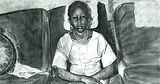
STORM
WARNING
A LESSON IN THE STILLNESS OF MOTION
An Essay on Perception, Structure, and the Instability of Space The work in Line, Value, Shape = Motionless Movement begins with a simple question: how can a still image carry the sensation of movement without depicting physical action? The answer, for me, does not come from gesture or narrative, but from the internal relationships between line, value, and shape. These elements, often considered foundational, become active forces that shape how space is experienced rather than simply how it is described. The origin of this investigation can be traced to a direct observation. While living in Nigeria, I watched a severe rainstorm move across an open landscape. As the rain advanced, it altered everything within view. The clarity of objects began to shift. Edges softened. Distance collapsed. The foreground, middle ground, and background no longer held their positions. Instead, they merged, separated, and reappeared in a continuous state of transition. What had once seemed solid became unstable, and what appeared distant moved closer through atmosphere rather than motion. That experience changed the way I understood space. Rain did not simply obscure vision; it revealed something more fundamental. It introduced a kind of transparency, a condition in which forms no longer existed as isolated objects but as part of an interconnected field. This perception brought to mind a parallel with atomic structure in physics, where matter is not defined by fixed edges but by relationships between particles. What we perceive as solid boundaries are, in fact, zones of interaction—constantly merging, overlapping, and shifting. The drawings that emerge from this understanding do not attempt to replicate the appearance of a storm. Instead, they recreate the condition it revealed. Through controlled shifts in charcoal line and value, forms are allowed to dissolve and reassemble within the picture plane. Edges are not fixed but negotiated. A figure may advance and recede at the same time. Space is no longer divided into stable layers but becomes a continuous field where elements interact. In this way, vibration becomes the central condition of the work. It is not a literal movement but a structural one. It exists in the tension between light and dark, in the compression of tonal relationships, and in the instability of boundaries that refuse to remain fixed. The eye moves across the surface not because something is happening within the image, but because the image itself is in a state of quiet fluctuation. The collages extend this investigation into material form. Torn paper introduces a physical edge that both interrupts and reinforces the illusion of space. While the drawings suggest permeability, the collages assert it through construction. The torn edge carries evidence of force, yet it also participates in the same merging of forms. The result is a dialogue between optical space and physical presence, where the two-dimensional surface begins to suggest a subtle third dimension. What connects all of these works is an interest in how perception operates under shifting conditions. The world is often understood through clarity, separation, and fixed relationships. This work suggests an alternative: that what we see is always in flux, shaped by atmosphere, proximity, and the limits of our own perception. Line, Value, Shape = Motionless Movement is not about movement in the conventional sense. It is about the recognition that stillness is rarely still. Beneath the surface of every image lies a network of relationships—merging, separating, and re-forming—that gives the work its energy. The image does not move. But it is never at rest.
Click Image Below to visit Motionless Movement Galleries


For those who see beyond the surface, collecting art is more than acquiring an image, it is living with an idea, a history, a memory, and a point of view.

STORM WARNING
VIBRATIONS
TORN PAPER
This series is my laboratory for drawing research. I explore how overlapping lines, tuned tonal fields, and interlocking shapes create motion in stillness. Each figure hums with optical tension, a kind of quiet vibration that pulls the eye into rhythm. I use tone like sound and line like gesture—sometimes sharp, sometimes tender, always alive. These drawings are not about depiction but about energy and attention: how the smallest line can shift the balance of a surface or the pulse of a composition. The challenge is to make static marks breathe, to find movement without relying on motion. Every piece becomes a meditation on the act of seeing, where stillness holds a visible heartbeat.